

Why WordPress Management Matters More Than Ever
Your WordPress Website Is Working Fine. So Why Pay Someone to Manage It?
It is a fair question.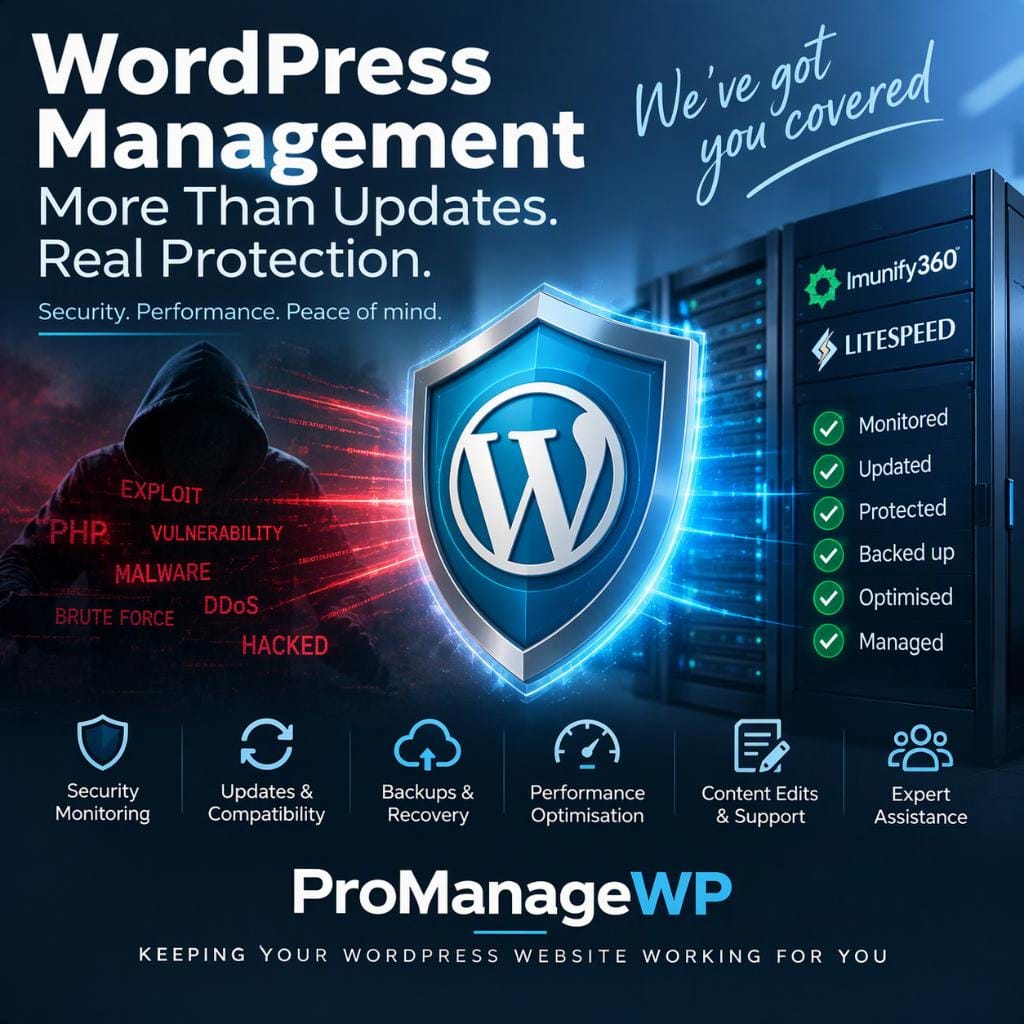
If your WordPress website is online, orders or enquiries are coming through and nothing appears to be broken, what exactly are you paying a WordPress management company for?
The answer became particularly clear in October 2026.
Two critical vulnerabilities were discovered in PHP, the software that sits underneath WordPress and millions of other websites. Collectively referred to as PHP2Shell, the vulnerabilities were particularly serious because they could potentially allow an unauthenticated attacker to execute code on a vulnerable server.
And this wasn’t simply another dodgy WordPress plugin.
It was a vulnerability in PHP itself.
That distinction matters because updating WordPress or clicking “Update Plugins” would not have fixed the underlying problem.
For businesses, incidents like PHP2Shell illustrate an uncomfortable reality of running a modern website:
A website doesn’t have to change for its security risk to change.
Your website might be exactly the same as it was yesterday. The threat environment around it isn’t.
What happened with PHP2Shell?
On 21 October 2026, PHP released security fixes for two critical vulnerabilities, CVE-2026-109618 and CVE-2026-109619.
Both were rated 9.2 out of 10 under CVSS v4.0.
More concerning was the speed at which events unfolded. Information about the vulnerabilities leaked before the planned disclosure, and a public exploit tool appeared before PHP’s security fix was released.
Imunify reported that by 11:00 UTC on 21 October, requests associated with the exploit had already reached more than 3,600 servers in its defence network.
That is a very different security environment from the days when a vulnerability might be announced and website owners had weeks to think about updating.
Today, the gap between “a vulnerability has been discovered” and “someone is trying to exploit it” can become extremely small.
What happened to websites hosted with ProManageWP?
This is where managed infrastructure earns its keep.
Our hosting environment uses LiteSpeed together with Imunify360, including server-level Web Application Firewall protection.
Imunify360 released protection targeting the known PHP2Shell exploit requests while patched PHP packages were being made available. On LiteSpeed, Imunify360 provided protection against the public exploit tool and known malicious request patterns under the conditions documented by Imunify.
Our managed environment therefore had an important additional layer of protection while the industry was responding to the vulnerability.
There is an equally important point here, though.
A firewall is not a substitute for patching vulnerable software.
Imunify itself makes that clear. The WAF provides an important defensive layer, while installing the corrected PHP packages addresses the underlying vulnerability.
That combination of monitoring, defensive infrastructure, updates and active management is what good website management should provide.
It is also something a business owner should not have to learn about at 10 o’clock at night because somebody has just emailed them an alarming security article.
PHP2Shell isn’t an isolated example
The WordPress security landscape has become extraordinarily active.
Consider just a few examples from 2026.
In April, one published WordPress vulnerability report listed 185 publicly disclosed vulnerabilities. At the time of that report, patches were available for 169 affected plugins and themes, while 16 remained unpatched.
During a single week in June, Wordfence reported 175 vulnerabilities affecting 157 WordPress plugins and two themes.
These aren’t all vulnerabilities carrying the same level of risk, and the existence of a vulnerability does not mean every WordPress website will be affected.
What the numbers demonstrate is the sheer pace of change.
WordPress itself is only one part of a typical website. A business website may contain WordPress core, a theme, numerous plugins and extensions, payment or eCommerce components, PHP and other server software.
Each component has its own development lifecycle.
And each can potentially introduce an issue that needs attention.
Attackers don’t necessarily wait for website owners anymore
One of the biggest changes in website security isn’t simply that vulnerabilities exist. They always have.
It is the speed at which vulnerabilities can be identified, published, scanned for and attacked.
Security research published in 2026 has highlighted how quickly heavily exploited WordPress vulnerabilities can progress to mass exploitation.
That changes what “website maintenance” means.
Waiting a few months and then logging into WordPress to update everything is no longer an adequate management strategy for a business website.
Nor is blindly switching on every automatic update and hoping nothing breaks.
Updates need to happen, but they also need to be managed.
That means knowing:
- what software a website is running;
- when important vulnerabilities have been discovered;
- whether the site is affected;
- what protections are already in place;
- when an update should be applied;
- whether that update creates compatibility problems;
- whether backups are available if something goes wrong; and
- whether the website is still functioning properly afterwards.
That is WordPress management.
“But my hosting company manages my WordPress hosting”
This is another common source of confusion.
Hosting and WordPress management overlap, but they are not necessarily the same service.
A hosting provider primarily provides the infrastructure that allows your website to operate.
Your actual WordPress website can contain software from many different vendors: themes, plugins, WooCommerce extensions, page builders, forms, backup tools, SEO software and custom code.
Someone still needs to look after that ecosystem.
At ProManageWP, that is our job.
We manage WordPress websites whether they are hosted with us or, where appropriate, hosted elsewhere.
Our management services include WordPress core, plugin and theme updates, compatibility checking, security monitoring, malware scanning, backups, uptime monitoring, performance optimisation and expert assistance.
When you also host with us, we can extend that responsibility into the hosting environment itself.
The PHP2Shell incident is a good illustration of why that distinction matters. The vulnerability wasn’t inside WordPress. It existed underneath WordPress at the PHP server level.
Website security doesn’t stop at the WordPress dashboard.
There is another side to website management: actually getting things done
Security is important, but it isn’t the only reason businesses use ProManageWP.
Websites rarely stand still.
Maybe you need to change a staff profile.
Add a new service.
Replace some photos.
Change prices.
Upload a PDF.
Fix an awkward page.
Add or replace a plugin.
Update contact information.
Make a small layout change.
Publish some new content.
Or perhaps something just isn’t behaving the way it should.
Not every business wants to employ a web developer or maintain an internal WordPress expert for this kind of work.
That is why ProManageWP also provides piece-work WordPress assistance and content editing.
If you need something changed, talk to us.
For many businesses, having someone who already understands WordPress and can step in when required is far more valuable than trying to remember how a particular page builder works six months after you last touched it.
What are you really paying for?
A WordPress management plan isn’t a subscription to press an “Update” button once a month.
It is paying for somebody to take responsibility for the ongoing health of a system your business relies upon.
You’re paying for:
Someone keeping watch.
Security problems and software vulnerabilities don’t arrive according to your diary.
Someone keeping things current.
WordPress, plugins, themes, PHP and hosting technologies continue to change after your website has been built.
Layers of protection.
Security shouldn’t depend upon one plugin or one firewall.
Recoverability.
Backups matter most on the day something goes wrong.
Compatibility management.
An update that improves security isn’t much help if nobody notices that it has broken your checkout or enquiry form.
Performance.
A website needs to remain useful to customers, not merely secure.
Someone to call.
When something breaks or needs changing, you don’t have to start searching Google for somebody who might be able to help.
A WordPress expert available for small jobs.
From content changes to troubleshooting, you have someone who already knows the platform and can get on with the job.
The best WordPress management is often invisible
There is a slight irony to what we do.
When WordPress management is working well, very little appears to happen.
Your website loads.
Your enquiry forms work.
Customers can purchase.
Updates happen.
Backups are taken.
Threats are blocked.
Problems are investigated.
Vulnerabilities are dealt with.
And you get on with running your business.
It is usually only when those things stop happening that website management suddenly becomes valuable.
October’s PHP vulnerabilities provided a very good reminder of that.
The internet has become a more automated, fast-moving security environment. WordPress remains an excellent platform for business websites, but owning a WordPress website also means maintaining a living collection of software.
You can take responsibility for monitoring and maintaining all of that yourself.
Or you can have someone else take responsibility for it.
That’s what ProManageWP is here for.
Frequently Asked Questions
What does WordPress website management include?
WordPress management is the ongoing work required to keep a website secure, current, backed up, monitored and working correctly. At ProManageWP, that includes areas such as WordPress core, plugin and theme updates, compatibility checking, security monitoring, backups, uptime monitoring and performance optimisation.
Isn’t keeping WordPress plugins updated enough?
No. WordPress is only one part of the environment your website relies on. Your website may depend on WordPress core, plugins, themes and PHP, as well as the web server and other hosting technologies. The PHP2Shell vulnerabilities demonstrated why security issues below WordPress itself can also matter.
What happens when a new WordPress or PHP vulnerability is discovered?
The appropriate response depends on the vulnerability and the software affected. This can involve determining whether a website or server is affected, monitoring available security information, applying appropriate security protections and installing vendor updates or patches when available. It is one of the reasons active website management is different from simply updating WordPress occasionally.
Can you guarantee that a WordPress website won’t be hacked?
No responsible provider can guarantee that a website will never be compromised. Good website security instead uses multiple layers to reduce risk, detect problems and provide a way to recover if something does go wrong. Those layers can include timely updates, server-level security, malware scanning, monitoring and reliable backups.
Do I have to host my website with ProManageWP?
No. ProManageWP can manage WordPress websites hosted elsewhere as well as providing managed hosting. Combining management and hosting gives us greater visibility over both the WordPress website and the server environment, but moving your hosting isn’t necessarily required to have us look after your WordPress website.
Can ProManageWP make small changes to my website as well?
Yes. We also provide piece-work WordPress assistance and content editing. That can include updating website content, changing images, adding pages or documents, troubleshooting problems and making other changes when required. It means you have somebody familiar with WordPress available without needing an in-house website specialist.
Let us look after your WordPress website
Whether you need ongoing WordPress management, secure hosting, assistance with an existing website or simply some content and website changes completed, ProManageWP can help.
We look after the technical work behind your website so that you can concentrate on the business the website is supposed to support.
Already managing everything yourself? Talk to us about taking the maintenance, security and monitoring off your hands.
Need something changed on your website? We also provide one-off and piece-work WordPress assistance.
Looking for hosting as well? Ask us about combining WordPress management with our managed hosting environment.
Your website doesn’t need attention only when something breaks.
The real value is having somebody there to help prevent it from breaking in the first place.